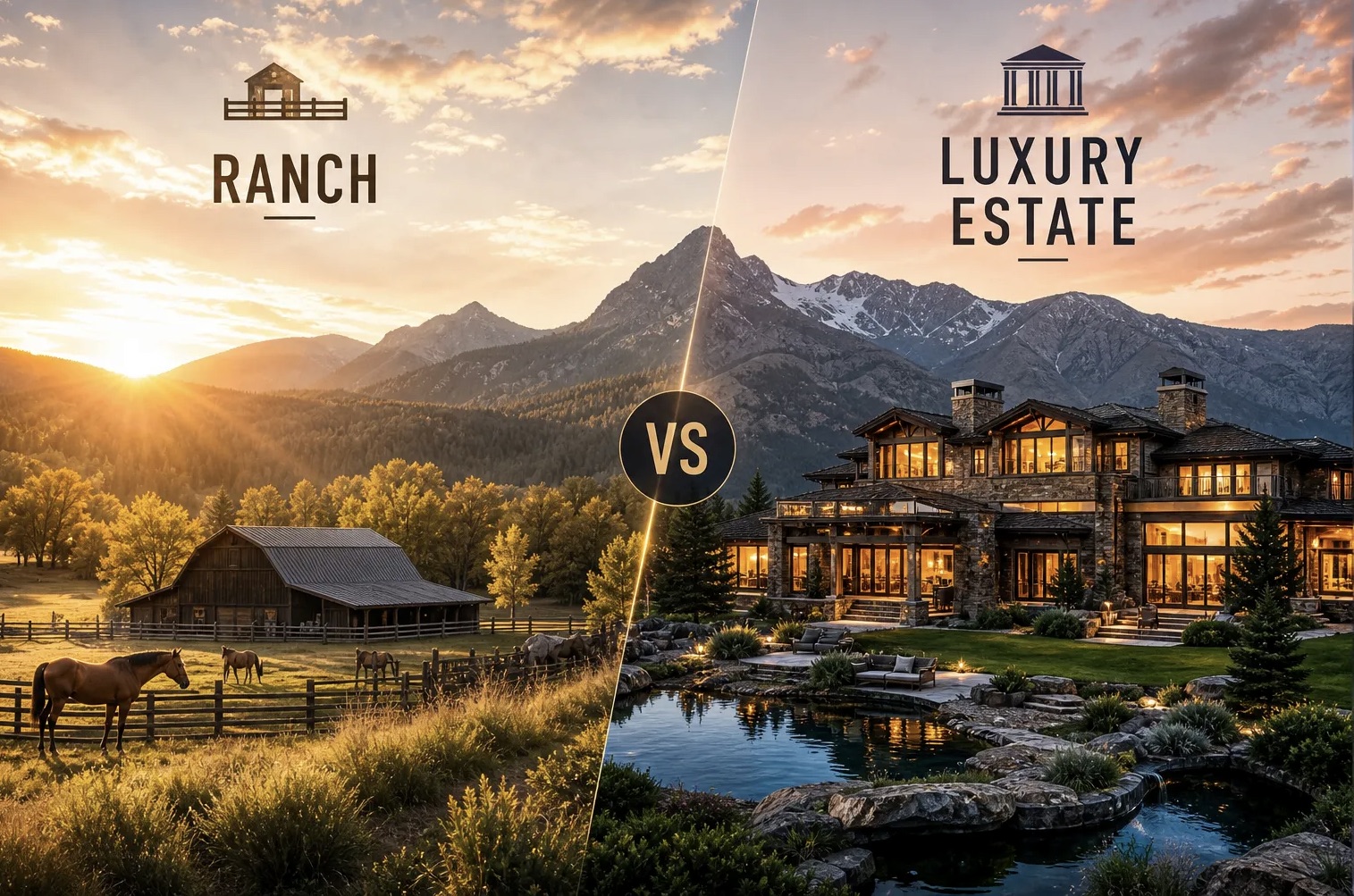
Should I buy a ranch or luxury estate near Aspen? Picture two properties separated by a single ridge in the Roaring Fork Valley. On one side: a 400-acre working ranch with senior water rights that may date to the 1880s, a conservation easement held by the Aspen Valley Land Trust, and wide-open grazing land stretching to the horizon. On the other: a 9,000-square-foot mountain estate behind a private gate, with a heated driveway, smart home automation, and a ski shuttle to the slopes. Both can cost north of $10 million. And they represent completely different ownership experiences.
The purchase price is where the similarity ends. Ranch buyers are acquiring land, water, and legacy. Estate buyers are acquiring curated mountain living with resort access built in. Before you schedule a showing on either, you need to understand what separates them across lifestyle, annual costs, taxes, investment return, and legal complexity. That's exactly what this guide covers.
What Life Actually Looks Like on a Ranch vs. a Luxury Estate Near Aspen
The Ranch Experience: Space, Solitude, and Working Land
Ranches near Aspen typically run 100 to 800-plus acres, with properties concentrated in areas like Emma, Missouri Heights, and down-valley toward Carbondale and Redstone. Privacy here isn't gated; it's structural. When your nearest neighbor is a mile away, you don't need a security patrol. What you do need is an operational mindset, because even a non-working ranch demands consistent attention: irrigation schedules, grazing lease management, fence maintenance, and equipment upkeep.
Many buyers hire a ranch manager or caretaker, which typically costs around 0.5% of market value annually plus a share of any rental income. This isn't a luxury add-on, it's a practical necessity. The land doesn't pause because you're in New York or Los Angeles for a month. How often will you actually be on the property? That question matters more here than with almost any other property type.
The Luxury Estate Experience: Curated Amenities and Managed Privacy
Luxury estates near Aspen, think Red Mountain, Starwood, or similar gated enclaves, offer 5,000 to 12,000-plus square feet of high-finish living. Smart home systems, professional landscaping, heated outdoor spaces, and proximity to Aspen's cultural and culinary scene define the day-to-day experience. Privacy comes from lot size and gating, not raw acreage. The lifestyle sits closer to a five-star second home than a land stewardship responsibility.
HOA structures in these communities handle common area maintenance, road management, and in some cases security patrols. Starwood, Aspen's only privately gated community, operates its own metropolitan district covering roads, water infrastructure, and security, and homeowners are actively encouraged to participate in wildfire mitigation programs. Annual HOA dues in gated luxury communities near Aspen vary considerably by community and amenity package, Starwood's dues, for example, have been reported in the range of roughly $2,200 to $3,500 per year, though you should confirm current fee schedules directly with each community before making any ownership assumptions.
Should I Buy a Ranch or Luxury Estate Near Aspen? Matching Lifestyle to Goals
Think of this as a decision matrix, not a ranking. Buyers who want land, legacy, solitude, and a direct relationship with the natural landscape gravitate toward ranches. Buyers who want turnkey luxury, easy lock-and-leave access, and proximity to Aspen's dining, arts, and ski culture lean toward estates. The practical question worth asking yourself: how do you want to spend your time on the property day to day, and how much operational involvement are you genuinely prepared for? Neither choice is wrong, they serve different life chapters and different family priorities.
True Cost of Ownership: What You'll Spend Beyond the Purchase Price
Purchase Price and What You're Actually Buying per Dollar
When buying a luxury estate near Aspen, price per square foot is the primary benchmark, and for top-tier properties on Red Mountain or in Starwood, those figures can be substantial. Consult current MLS comps or a local buyer's agent for neighborhood-specific data before underwriting a deal. Ranches trade differently: price per acre and total operating infrastructure drive the valuation. Water rights, outbuildings, irrigation systems, and existing grazing leases are all priced into the deal. A 400-acre ranch near Carbondale and a 9,000-square-foot estate on Red Mountain can carry similar sticker prices with entirely different underlying asset compositions.
Understanding what you're buying per dollar matters because it shapes your exit strategy. Estate values are benchmarked against a deep pool of comparable sales. Ranch values require specialized appraisers who assess water rights, agricultural improvements, and conservation status independently, often as separate line items within a single appraisal report.
Annual Operating Costs Compared
Ranch operating costs for a viable 100- to 800-acre operation typically run $150,000 to $200,000 per year, covering maintenance, equipment, and utilities (let along staffing). Luxury estate costs range from $120,000 to $250,000-plus annually. Those estate costs are driven by full-service staffing, house manager, groundskeepers, security, along with high-end finishes maintenance and the significant heating demands of a high-altitude mountain home. Ranch costs are generally more predictable; estate costs are more variable and amenity-driven.
The Costs Most Buyers Underestimate
For ranch buyers, the surprises often come from irrigation infrastructure repairs, water augmentation fees (which can run $40 to $150 per acre annually in over-appropriated water systems), and equipment replacement cycles. For estate buyers, the underestimated costs are wildfire insurance premiums in Pitkin County, which have climbed sharply since 2022, HOA special assessments for capital improvements, and the accelerated wear on custom finishes caused by mountain freeze-thaw cycles. As a general planning guideline, building a 15 to 20% contingency above your projected annual operating costs is a reasonable buffer for either property type, speak with a local CPA or property manager to calibrate that figure for your specific situation.
The Tax Picture: Agricultural Benefits, Pitkin County Rates, and HOA Structures
Agricultural Tax Designations and What They Save Ranch Buyers
Colorado assesses agricultural land at 25% of actual value for property tax purposes. A ranch with an active agricultural designation carries a dramatically lower annual tax bill than a luxury estate at the same market value. Conservation easements can further reduce assessed value by removing the development premium from the land's appraisal, locking in agricultural tax status permanently.
Before you assume these benefits transfer, verify the current agricultural designation status in the county records. Not every ranch-like property carries a formal ag designation, and the difference in annual tax exposure can be substantial.
Pitkin County Property Tax Rates in Practice
The median effective property tax rate in Aspen and Pitkin County sits at 0.22%, well below the national median of 1.02%. That sounds favorable until you apply it to a $10-plus million property: the 90th percentile annual tax bill in the county reaches approximately $42,165. Rates vary by ZIP code and subdivision. Properties in the 81612 ZIP average a 0.30% effective rate while 81611 averages 0.19%. Colorado reappraises property values every two years, with the current valuation cycle active in 2026, so expect assessment notices this year. For a concise summary of current local tax rates, refer to the Pitkin County tax rates overview provided by Avalara (Pitkin County tax rates).
Investment Potential and Rental Income: Which Performs Better
Resale Value Trends and Buyer Pool Depth
Luxury estates on Red Mountain and in Starwood attract a broad international buyer pool, the same buyers shopping Aspen's core residential market. Resale liquidity is higher because the buyer universe is larger and the comparable sales data is deeper. Luxury homes in Pitkin County average around 130 days on market, with the broader county median around 111 days. See current local market snapshots for Pitkin County to compare activity across neighborhoods (Pitkin County real estate market).
Ranches trade to a narrower audience: land buyers, conservation-focused buyers, legacy buyers, and agricultural investors. That narrower pool can mean longer time on market, but rare properties with senior water rights and strong conservation profiles often command significant premiums from highly motivated buyers. Ag/residential properties in Pitkin County saw appreciation rates as high as 117% in recent reappraisal cycles, suggesting that the right ranch, priced correctly, can perform exceptionally well.
Short-term Rental Rules and Seasonal Income Potential
Luxury estates in Aspen's core can generate $500 to $750-plus per night in peak winter and spring under the city's STR permitting system. Owner-occupied permits cap annual rental at 120 nights; non-owner STR-Classic permits have no annual night limit in qualifying zones but face caps in residential areas. Estates positioned in lodging zones have the clearest path to maximizing rental income. For more on the distinctions between different lodging and rental strategies, see our analysis on Aspen Hotel Condo vs Vacation Rental: Which is Better?.
Ranches outside Aspen's city limits fall under Pitkin County's STR rules, which limit seasonal permits to 75 county-wide (covering 61 to 120 nights per year) and require documented prior rental history. The county's restrictive permit caps make rental income a less reliable income thesis for most ranch buyers. Recent reporting on the county's new short-term rental rules explains how supply caps and permit limits are reshaping seasonal rental availability (new short-term rental rules in Pitkin County).
Which Type Builds Long-Term Wealth More Predictably
Luxury estate appreciation near Aspen tracks the broader ultra-luxury mountain market with a consistent floor of demand. For buyers whose primary goal is capital appreciation, estates offer more comparable sales data, cleaner financing options, and faster resale timelines. Ranches with conservation easements carry reduced development value by design, but that protection also insulates them from speculative price collapses. They're wealth preservation assets more than growth assets, a profile that suits a specific type of buyer very well.
Legal and Operational Complexity: Water Rights, Easements, and Zoning
Water Rights and Why They Matter More Than Most Buyers Expect
Colorado follows the prior appropriation doctrine: "first in time, first in right." Senior water rights attached to a Roaring Fork Valley ranch can date to the late 1800s and, in drought years, may be worth more than the land itself. Buyers must verify the type of rights (direct-flow versus storage), their priority date, and whether they are fully adjudicated. Many conservation easements now restrict the separate sale of water rights, permanently tying them to the land. For a clear primer on how the prior appropriation system works and what buyers should verify, consult authoritative water-rights resources (water rights and the prior appropriation system).
During a property sale, water rights appurtenant to the land generally transfer with the parcel, but ditch shares are separate interests that require confirmation with the ditch company. Any buyer considering a ranch purchase near Aspen needs a water attorney involved before going under contract, not after.
Conservation Easements and How They Shape Your Ownership
Easements on Aspen-area ranches are permanent deed restrictions held by land trusts like the Aspen Valley Land Trust. They restrict subdivision, commercial development, and often new residential construction beyond what's already permitted on the property. In exchange, the original grantor received a tax deduction based on the development value that was permanently removed at the time of the easement donation. For practical guidance on drafting conservation easements tailored to agricultural and ranch land, see this overview on drafting conservation easements for agricultural and ranch land (drafting conservation easements).
For buyers, this means you own the land but not its full development optionality. The practical upside: agricultural tax status is locked in, the landscape is protected from future development pressure, and at resale you attract buyers who specifically value that protection. It's a different asset than a developable parcel, and it needs to be underwritten as such.
Zoning Rules and What You Can Actually Build or Change
Pitkin County's land use code governs both property types, but the restrictions differ significantly. Agricultural zoning restricts residential density and favors low-impact agricultural use. Residential estate zoning allows significant improvements but may restrict guest houses, caretaker units, and short-term rental use depending on the specific zone district. Any buyer planning to develop, expand, or change the use of a property should review Pitkin County's current land use regulations with a local attorney before signing a purchase contract.
How to Take Your Next Steps in the Roaring Fork Valley
A Practical Due Diligence Checklist Before You Make an Offer
For either property type, your pre-offer checklist should include the following:
- Verify the current agricultural designation and assessed value with the Pitkin County Assessor
- Pull all recorded conservation easements from the county clerk and review restrictions in full
- Obtain a complete water rights abstract and confirm adjudication status with a water attorney
- Confirm STR permit history, eligibility, and current permit caps for the zone
- Review full HOA financials, CC&Rs, and any pending special assessments (for estates)
- Commission a licensed survey that includes water infrastructure (for ranches)
Neither property type should go under contract without a local real estate attorney and a title company experienced in Pitkin County transactions. These aren't optional steps, they're the difference between a clean closing and a costly surprise.
Where to Browse Ranch and Estate Listings Side by Side
Aspen Real Estate Search is a platform built specifically for the Roaring Fork Valley, letting you filter and compare ranches, acreage parcels, and luxury estates in one place. Unlike national portals that treat Aspen as just another ZIP code, this platform aggregates the full spectrum of Pitkin and Garfield County property types, including working ranches with agricultural designations, conservation parcels, and high-finish luxury estates in gated communities. You can browse both categories side by side, filter by acreage, price, and property type, and get a real picture of what's available right now across Aspen, Snowmass, Basalt, and Carbondale. If you're still asking yourself, "Should I buy a ranch or luxury estate near Aspen?", browsing current listings is the fastest way to make the question concrete. Also consider reading our detailed guide on Buying Property in Aspen, Colorado: The 2026 Guide to help structure your search and due diligence.
Final Thoughts: It's a Fit Question, Not a Better/Worse question
Ranches near Aspen offer solitude, land legacy, agricultural tax advantages, and permanent landscape protection. The tradeoffs are real: operational complexity, narrower resale liquidity, and a transaction process that demands specialists most buyers haven't worked with before. Luxury estates offer turnkey mountain living, stronger rental income access, and a deeper pool of buyers at resale. The tradeoffs there are HOA constraints, higher variable operating expenses, and wildfire insurance premiums that continue to climb.
Whether you should buy a ranch or luxury estate near Aspen ultimately comes down to how you want to spend your time on the property, your investment horizon, and how much operational complexity you're willing to manage long-term. Neither path is wrong for the right buyer. Start by browsing both categories on Aspen Home Listings to see what's actually available in the valley right now, then build your advisory team, a local buyer's agent, a real estate attorney, and a CPA with Colorado agricultural tax experience, before you move any further. If you need help assembling that team, our piece on How to Find a Luxury Mountain Real Estate Professional outlines the specialists to engage and how to vet them.