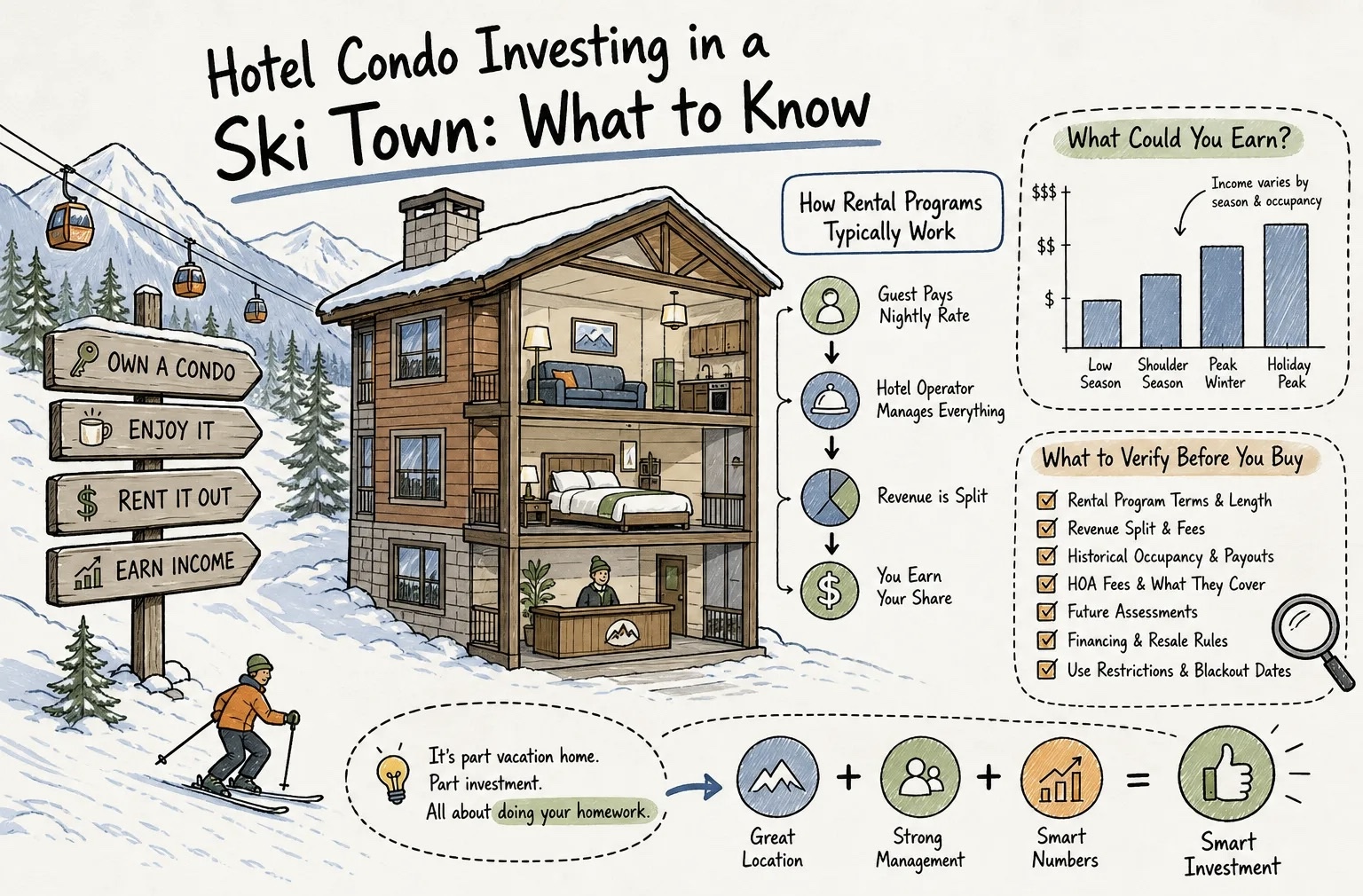
If you're asking what is a hotel condo and how does it work, the short answer is this: a hotel condo is individually deeded real estate inside an operating hotel. You hold a fee-simple deed to a specific unit, but a hotel company manages the property, rents your unit to guests when you aren't using it, and splits the revenue with you under a formal rental program agreement. That structure differs fundamentally from a standard vacation rental condo: you own the unit, but you don't control pricing, booking schedules, or when your unit is available to you.
Buyers often confuse condo-hotels with timeshares or fractional hotel ownership. All three involve resort properties, but only a hotel condominium gives you a recorded deed to real property. A timeshare gives you a right to use, not ownership. Fractional ownership splits one deed among multiple buyers for defined use periods. This guide covers what a condotel buyer actually owns, how the rental revenue waterfall works, what net income to expect, how to finance the purchase, and what to verify before signing anything.
If you're evaluating hotel condominium opportunities alongside ski condos and vacation rental properties in Aspen or Snowmass Village, Aspen Real Estate Search catalogs all three property types in one platform so you can run side-by-side comparisons before engaging an attorney or lender.
Key Takeaways
- Deeded ownership, not a license: You receive a fee-simple deed to your unit, governed by a condominium declaration, bylaws, and CC&Rs.
- Revenue split complexity: A 50/50 headline split rarely tells the full story. Multiple deductions come out before the split, reducing your actual net payout significantly.
- Financing is harder: Conventional, FHA, and VA loans typically cannot be used for condotels. Budget for 25–35% down through specialty financing, a commonly cited range among specialty lenders.
- Due diligence is essential: Request three years of actual owner distributions, the full revenue waterfall, and a lender pre-qualification before making any offer.
What is a Hotel Condo and How Does it Work: What You Actually Own
When you purchase a hotel condo, you receive a deed to a specific unit, just as you would with a residential condominium. The condominium declaration defines your unit boundaries, your ownership percentage of common elements, permitted uses, and assessment obligations. Those documents, along with the bylaws and CC&Rs, govern your legal rights as an owner.
What you don't own is the hotel business itself. In most condo-hotel projects, the lobby, front desk, restaurants, pools, mechanical systems, and guest amenities are owned separately by the developer or an affiliated hotel entity, not the condominium association. The hotel operator runs reservations, housekeeping, marketing, and pricing under a long-term management or branding agreement that sits entirely outside your deed. Buying a hotel condo means owning real estate inside a hotel business, not a share of the hotel business itself. That distinction matters for income expectations, control, resale value, and financing. The exact scope of what your association owns versus what the hotel entity controls must be confirmed in the recorded declaration, not assumed from the sales presentation.
How the Rental Program Splits Revenue (and What Gets Deducted First)
Most hotel condo rental programs use a gross-to-net revenue waterfall. Gross room revenue flows in, deductions come out, and the remaining adjusted revenue is then split between the owner and the operator, commonly on a 50/50 basis. The critical detail is what gets deducted before that split occurs.
A management or service fee is typically deducted first. Marketing fees, online booking commissions, housekeeping costs, credit-card processing charges, and reservation expenses are then deducted as operating costs before the adjusted revenue is calculated. These are rarely advertised as separate line items. A furniture, fixtures, and equipment (FF&E) reserve is also commonly withheld for future furnishings replacement and renovations.
Two programs advertising the same 50/50 split can produce very different net results depending on what is deducted before the split. Industry modeling cited by Hospitality Net puts the typical condo-hotel owner distribution at around 45% of gross rental revenue, compared with approximately 65% for vacation rentals. Because pre-split deductions vary by program, the actual dollars reaching an owner can shrink well below what the headline percentage implies. Always request a written revenue waterfall, not just the headline percentage.
HOA dues operate separately. They are charged based on your unit's allocated share of common expenses and are not calculated as a percentage of rental income.
What You Can Realistically Earn from a Condo-Hotel
Gross revenue projections from developers and sellers tend toward optimism. The more reliable starting point is actual owner distributions over three or more years, normalized for owner-use nights and any closure periods. According to CoStar, U.S. hotels produced 62.3% average occupancy and a $160.54 average daily rate in 2025.
In a high-demand ski resort market like Aspen or Snowmass, peak-season performance pushes occupancy and ADR sharply upward. Owner-use nights and rental restrictions reduce the available room count, however, compressing effective occupancy below the headline figure. As a practical underwriting framework, hotel-market benchmarking sources generally distinguish three tiers: weaker or off-peak market conditions (roughly 55–65% occupancy), strong leisure locations (65–80%), and exceptional peak-heavy properties (80% or above). Treat these as illustrative ranges rather than guarantees.
For yield, underwriters commonly reference a net operating return before debt service in the 3–5% range as a baseline for an acceptable investment, with figures below 3% warranting hard scrutiny. Stress-test your projections at 55%, 65%, and 75% occupancy before making a purchase decision. Owner-level costs will reduce actual cash flow further.
Is Financing a Hotel Condo Harder than a Regular Condo?
Conventional, FHA, and VA loans generally cannot be used for condotels. Mandatory rental pools, hotel management agreements, and commercial-use classifications disqualify most condo-hotel projects from standard agency lending requirements. The building itself must pass project-level underwriting, not just the individual unit.
The most common financing path is a DSCR loan, where qualification is based on the unit's projected rental income relative to debt service, taxes, insurance, and assessments, rather than on the borrower's personal income documentation. Specialty lenders commonly cite a 25–35% down payment as the planning range, with 65–75% LTV as the practical target. Cash-out refinances typically cap at 55–65% LTV. Other options include full-doc non-QM loans, bank-statement loans, asset-depletion loans, and portfolio or jumbo products from specialty lenders, all carrying higher rates than a standard residential mortgage.
Expect higher reserve requirements, possible prepayment penalties, and full underwriting of the building's HOA financials, rental history, and management agreements. Before submitting an offer, ask the seller's agent what financing has successfully closed in that specific building. If no lender has completed a purchase loan there recently, that is a material risk factor worth investigating before you proceed.
Hotel Condo vs. Vacation Rental Condo: What Actually Changes for the Owner
The core tradeoff is control versus convenience. With a vacation rental condo, you control pricing, platform selection, cleaning schedules, and guest selection. You bear full management responsibility or hire a property manager directly. With a hotel condo, the operator controls all of that. You trade day-to-day management burden for reduced flexibility and dependence on the operator's performance and fee structure.
| Factor | Hotel condo | Vacation rental condo |
|---|---|---|
| Pricing control | Operator sets rates | Owner sets rates |
| Booking platforms | Hotel reservation system and loyalty programs | Owner selects (Airbnb, VRBO, direct, etc.) |
| Management burden | Low: operator handles operations | Higher: owner manages or hires PM |
| Owner use flexibility | Restricted by program agreement and blackout dates | Owner controls scheduling |
| Net payout structure | Revenue waterfall with multiple pre-split deductions | Gross revenue minus direct costs and PM fee |
| Resale buyer pool | Narrower, especially with mandatory rental-pool participation | Broader residential and investor appeal |
| Financing options | Specialty lenders only; 25–35% down | Conventional financing may apply |
Resale of a hotel condo may draw from a narrower buyer pool, particularly when rental-pool participation is mandatory or the building is associated with a specific brand. Compare recent same-building resales against nearby non-hotel condo comparables to gauge liquidity before you commit. The branded reservation system and loyalty programs a hotel condo offers can support revenue during shoulder seasons, but the owner's net payout is shaped entirely by the operator's fee structure, not the gross booking volume.
What to Verify Before You Sign Anything
The documents every buyer must read include the declaration, bylaws, and CC&Rs to confirm what the association controls versus the separate hotel entity; the rental-program agreement to verify the full revenue waterfall, all pre-split deductions, blackout periods, audit rights, and termination provisions; the hotel management or branding agreement to understand the operator's term length and what happens if the brand exits; and the HOA financials, reserve fund balance, special assessment history, and pending litigation.
Before closing on any condo-hotel, get answers in writing to these ten questions:
- What is the gross-to-net revenue waterfall, in full written detail?
- Are owner-use nights limited by season, total number, or specific blackout dates?
- What is the FF&E reserve rate and when is it replenished?
- Can I exit the rental program, and at what cost or penalty?
- Who owns the lobby, amenities, and operating facilities?
- What are the HOA dues and what expenses do they specifically cover?
- What financing has successfully closed in this building, and with which lenders?
- What are the last three years of actual owner distributions, not projected income?
- What is the average marketing time for resales in this building?
- What happens to my unit if the hotel operator exits or the brand changes?
Make the Decision with Complete Information
Understanding what is a hotel condo and how does it work comes down to one core reality: it is deeded real estate integrated into a hotel operation, with genuine income potential, significant fee complexity, and ownership restrictions that standard condos don't carry. The headline 50/50 split rarely tells the full story. Net yield after all pre-split deductions, reserve contributions, HOA dues, taxes, and insurance is what determines whether the investment works for you.
Before making any offer on a condo-hotel, obtain the full revenue waterfall in writing, three years of actual owner distributions, and a financing pre-qualification from a lender experienced with condotels. Those three documents will tell you more than any sales presentation.
For anyone exploring the Aspen or Snowmass Village luxury resort market, Aspen Real Estate Search consolidates hotel-condo, vacation-rental, and ski-property listings in one hyper-local platform designed for this market. Everything is in one place, so you can compare all your options with clarity before your first conversation with a broker.
Frequently Asked Questions
Do HOA dues get calculated as a percentage of my rental income?
No, HOA dues operate separately and are not calculated as a percentage of rental income. We state that dues are charged based on your unit's allocated share of common expenses, independent of the revenue waterfall.
Will owner-use nights affect the occupancy figures for my unit?
Yes, owner-use nights and rental restrictions reduce the available room count and compress effective occupancy below headline market figures. We note that this effect can lower your unit's realized occupancy compared with published hotel-market occupancy rates.
What is the role of an FF&E reserve in the revenue waterfall?
An FF&E reserve is commonly withheld from gross revenue before the owner/operator split as a fund for future furnishings replacement and renovations. We explain that this pre-split deduction reduces the adjusted revenue that gets split, so different programs with similar headline splits can yield different net results.
Buying or Selling a Hotel Condo in Aspen or Snowmass? Contact David for more information.